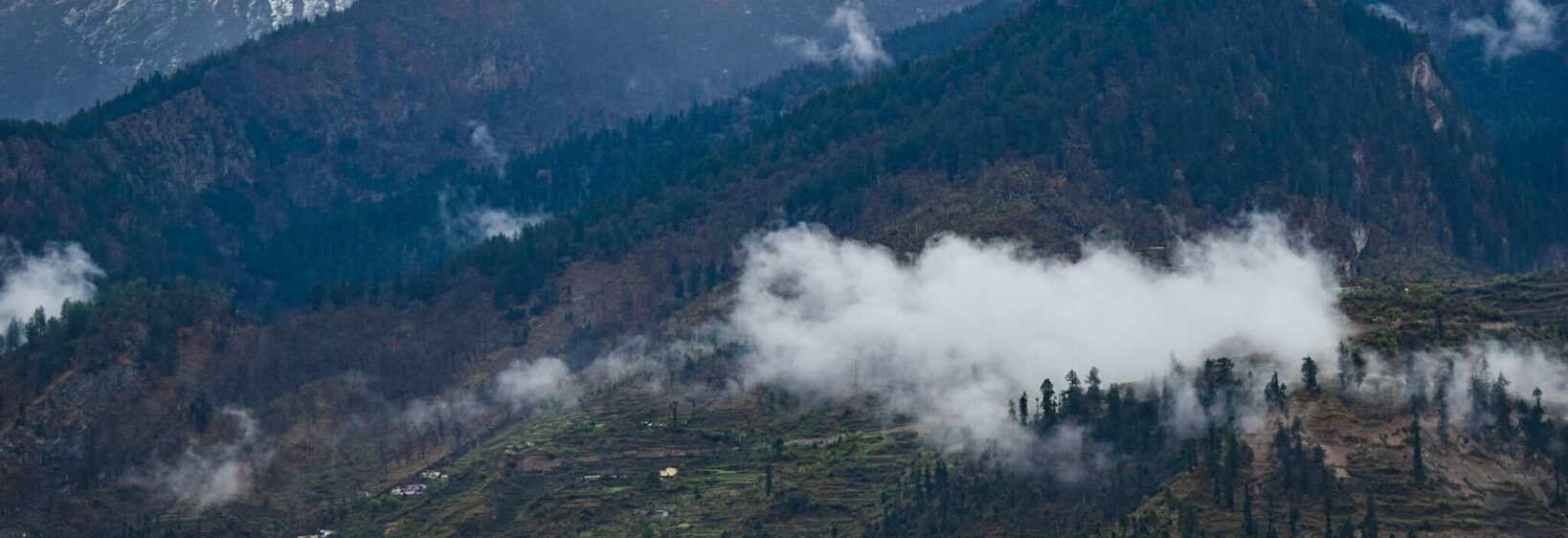
Chamba township and its colonial church above the Tehri hills
Perched quietly above the swirling Bhagirathi valley, Chamba is the sort of Uttarakhand hill town that rewards slow looking. Its weathered colonial church, broad ridge views, and pine-scented lanes have drawn visitors for over a century, and the panorama across the Tehri hills remains the chief reason travellers keep coming back.
For Australians used to long drives through the Great Dividing Range or a weekend in the Blue Mountains, Chamba offers a similar sense of altitude and escape, yet the scale of the Himalayas is entirely different. The roads switchback endlessly, the valleys drop thousands of metres, and the air carries the scent of pine rather than eucalyptus.
Comparing nearby hill settlements
| Destination | Distance from Chamba | Main attraction | Best season |
|---|---|---|---|
| Chamba | — | Colonial church and Tehri hills panorama | March to June, September to November |
| Mussoorie | 95 km | Mall Road and Camel's Back Road | April to June |
| Kanatal | 22 km | Apple orchards and Surkhanda Devi temple | September to December |
| Dhanaulti | 35 km | Eco Park and deodar forests | October to February |
| Tehri | 60 km | Tehri Dam and Bhagirathi reservoir | All year |
This table helps travellers planning a circuit, though most choose Chamba specifically for its quiet cantonment atmosphere and the angle it provides on the Tehri range.
The setting and approach
The township sits at roughly 1,500 metres on a saddle between the Bhagirathi and Bhilangna rivers. The drive from Rishikesh takes around six to seven hours, climbing through Sal forests and terraced fields. For those who know the Hume Highway between Sydney and Melbourne, the ascent is comparable in length but far steeper in gradient.
Old Chamba, the original British-era settlement, clusters around the church and a few colonial bungalows, while New Chamba spreads further down the ridge with markets, guesthouses, and the bus stand. The two halves are linked by a winding kilometre of road, often walked by visitors who want to stretch their legs after the long climb from the plains.
Architecture of the colonial church
The Anglican church of St John dates from the late nineteenth century, built when Chamba served as a summer retreat for British officials. Its stone walls, pointed arch windows, and modest steeple reflect the provincial Gothic style common to hill stations from Shimla to Darjeeling.
Inside, the original teak pews, brass fittings, and a small bell imported from Glasgow still draw photographers and architecture enthusiasts. The cool interior is a relief on summer afternoons when temperatures outside climb into the high twenties. For Australians familiar with the bluestone churches of Melbourne's western suburbs or the sandstone heritage of Sydney's Rocks, the materials feel familiar even if the setting is entirely foreign.
Vistas across the Tehri hills
The real showpiece is the view eastward across the Tehri hills. On clear mornings, the snow line of the Gangotri group appears above a jumble of forested spurs, while closer ridges step down toward the blue ribbon of the Bhagirathi. Photographers often arrive at sunrise, when mist pools in the valleys and the peaks turn gold.
The best vantage points lie along the ridge road above the church and on the short trail toward the telecom towers. For landscape photographers who also follow coastal work, near the lighthouse documents a very different kind of horizon, though the patience required is much the same.
A few kilometres north, the massive wall of Tehri Dam becomes visible, holding back the Bhagirathi in one of the highest reservoirs in Asia. Many combine the dam visit with a stay in Chamba, using the town as a base for slow exploration rather than rushing through.
Local life and surrounding trails
Chamba's working life centres on apple growing, small-scale tourism, and government services. The market is compact, with a handful of shops selling local woollens, pahadi honey, and pulses. Travellers who enjoy weekend markets in Adelaide or Byron Bay will appreciate the unhurried rhythm, though the scale is closer to a village bazaar than a regional centre.
Short walks radiate from the town. The trail to Kalindi Khal base camp passes through oak and rhododendron, while a gentler path loops through the deodar groves below the church. Most visitors spend two or three nights, mixing gentle walks with long sessions on the church veranda, reading or sketching.
Pilgrims heading to Kedarnath or Yamunotri often pause here to break the journey. The town offers a quieter alternative to the busier stops at Haridwar and Rishikesh, and the altitude is enough to begin acclimatising without the crowding of higher settlements.
What to bring and what to leave behind
- Warm layers, even in summer, as evenings drop sharply after sunset
- A torch for the unlit lanes between Old and New Chamba
- Sturdy walking shoes with grip for the sloped paths
- A reusable water bottle, as the market in Chamba is reliable but spring water varies by village
Permits and practicalities
- Carry passport-sized photos for any check-posts, as the region borders sensitive zones
- Inform your guesthouse of trekking plans, similar to registering with NSW National Parks
- Carry cash, as ATMs are limited and mobile networks patchy beyond the town
Photographers and curious travellers often combine a stay here with broader circuits through the Garhwal. Detailed photo essays and route notes from the region are collected on ukphotosgallery.com, alongside guides to nearby destinations such as Joshimath, Ranikhet, and Deoria Tal. Australians planning the trip should also note Australia's strict biosecurity rules: on return, declare any wooden souvenirs, seeds, or honey, since Biosecurity Tasmania, Agriculture Victoria, and federal inspectors enforce heavy fines for undeclared plant or food matter.