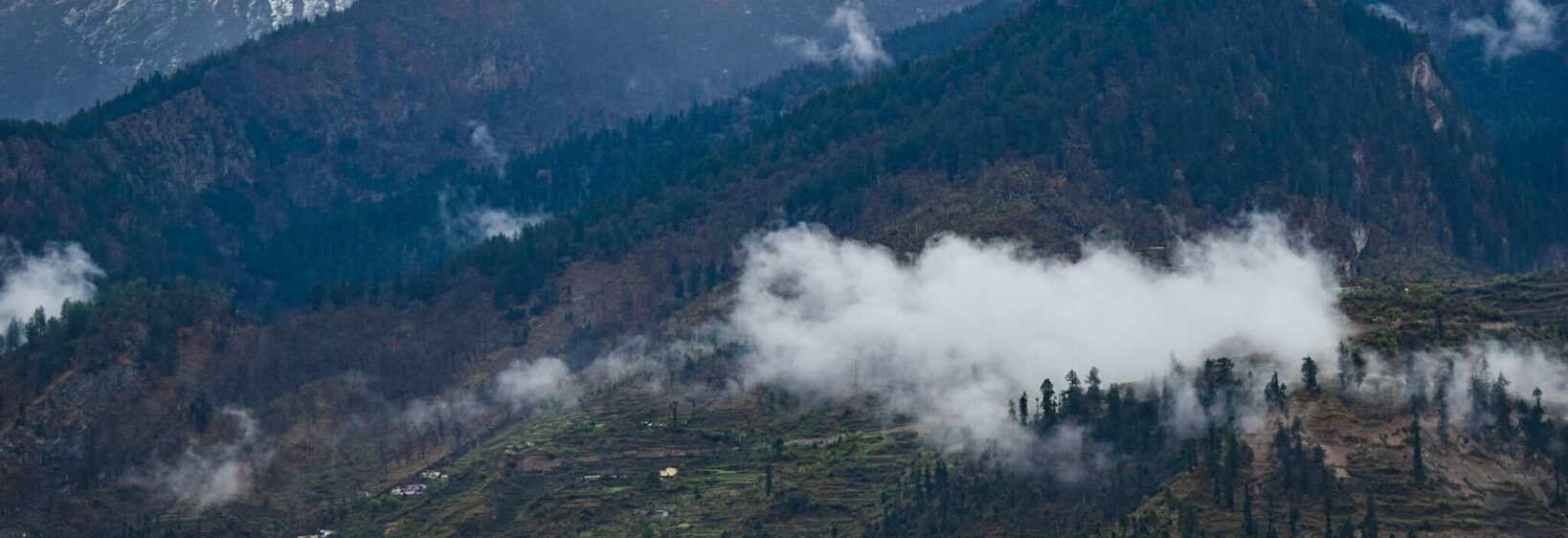
Photographing the Terraced Fields of Munsiyari
Munsiyari’s terraced fields spread across mountain slopes like carefully drawn steps, changing colour with the seasons. In spring, young crops create fresh green patterns; after harvest, golden stubble and dark soil give the landscape a quieter, textured character. Behind them, the Panchachuli peaks add a dramatic Himalayan backdrop.
These farms are more than scenic foregrounds. They reflect the rhythm of rural life in Kumaon, where stone houses, footpaths, irrigation channels, cattle sheds, and cultivated terraces form a living landscape. A thoughtful photograph should preserve that connection rather than treating the fields as an empty pattern.
The best images often come from slowing down, watching the light, and walking beyond the first roadside viewpoint. Munsiyari photography rewards patience, especially when clouds move across the ridges and sunlight briefly touches a distant village.
Finding the right viewpoint
Start by exploring slopes and trails around Munsiyari instead of relying on a single popular lookout. A slightly elevated path can reveal the curves of the terraces, while a lower position makes the walls and crops feel more imposing. Look for a composition where the fields lead the eye towards forested ridges or snow-covered summits.
Early morning is ideal for soft light, thin mist, and cooler colours. The low sun creates long shadows along the retaining walls, making each terrace easier to distinguish. Late afternoon offers warmer tones and often produces a more atmospheric view of the Himalayan range.
Avoid placing the tallest peak directly in the centre of every frame. Offset it with a village roof, a line of trees, or a winding trail. This creates balance and gives the landscape a stronger sense of depth.
Working with light and weather
Weather in Munsiyari can change rapidly, which is an advantage for landscape photographers. Passing clouds create moving patches of shade, while a short break in the cloud cover may illuminate just one section of farmland. Keep your camera ready during these brief transitions.
Overcast conditions are useful for close photographs of crops, stone walls, and wet pathways. Diffused light reduces harsh contrast and brings out subtle greens, browns, and grey-blue tones. After rain, saturated colours and reflections in small puddles can add freshness to an otherwise familiar scene.
When the sun is strong, use the shadow of a wall or tree to protect the highlights in your image. A polarising filter can reduce glare from foliage and improve the definition of distant ridges, although it should be rotated carefully to avoid uneven skies.
Choosing lenses and camera settings
A wide-angle lens works well for expansive views, but an ultra-wide lens can make the terraces appear distant and insignificant. A moderate focal length often produces a more natural relationship between the fields and the Panchachuli range. A telephoto lens is valuable for isolating repeating terrace lines, distant homes, or farmers working between crops.
Use a low ISO whenever light allows, particularly for detailed landscape images intended for large prints. An aperture around f/8 or f/11 usually provides good depth of field, while a faster shutter speed helps when wind moves crops or people are walking through the frame.
Shoot in RAW if possible, and check the histogram rather than trusting the brightness of the camera screen. Bracketing can help when a bright sky sits above shadowed terraces. Keep exposure compensation slightly negative when snow peaks or bright clouds risk losing detail.
Building a visual story
A strong Munsiyari photo essay should include more than sweeping panoramas. Combine wide landscapes with medium-distance scenes and intimate details. This sequence can show how the fields fit into village life and how traditional farming shapes the hills.
| Scene | Useful approach | Visual purpose |
|---|---|---|
| Terraces and peaks | Wide or moderate lens, low ISO | Establishes scale and location |
| Stone retaining walls | Side light, close focus | Shows texture and craftsmanship |
| Farmer in the field | Ask permission, use a natural perspective | Adds human connection |
| Crops and irrigation channels | Diffused light, careful framing | Records seasonal detail |
| Village path through fields | Leading lines, moderate aperture | Guides the viewer through the landscape |
Include a frame of a footpath disappearing around a bend, or a person carrying tools along the edge of a field. These details give the viewer a feeling of movement and place. For visual references from across the region, the Uttarakhand photo gallery can also provide ideas for combining landscape views with cultural scenes.
Respecting local life
Terraced farmland is often privately managed and actively used. Ask before entering a field, photographing residents at close range, or including children in a frame. A polite greeting in Hindi or Kumaoni can create a warmer interaction than silently raising a camera.
Do not step on young crops or climb over stone boundaries for a better angle. Remain on public paths whenever possible, and avoid blocking narrow routes used by residents carrying grass, firewood, or produce. These small choices protect both the landscape and the trust of the people who live there.
Consider photographing ordinary details: hand tools beside a wall, grain drying in the sun, a pair of worn sandals near a field entrance, or smoke rising from a distant kitchen. Such images can communicate the character of Munsiyari more honestly than staged portraits.
A practical field checklist
Munsiyari’s altitude, uneven trails, and changing weather make preparation essential. Carry only the equipment you can comfortably use while walking, and protect it from dust, rain, and sudden drops in temperature.
Before leaving for a sunrise or sunset session, check local conditions and tell someone your route. The following habits help keep the shoot efficient:
- Carry spare batteries, memory cards, a lens cloth, and a lightweight rain cover.
- Wear shoes with firm grip because terrace paths can be loose, muddy, or steep.
- Pack a telephoto lens or compact zoom for distant peaks and working farmers.
- Use a tripod for low-light scenes, bracketed exposures, and carefully aligned panoramas.
- Bring water and snacks, and leave enough time to return before darkness.
A simple camera setup, careful observation, and respectful movement are often more valuable than a large kit. Let the changing light guide the session, and revisit the same viewpoint when possible; the fields may look entirely different after rain, harvest, or the arrival of winter.
Share your best terraced-field photographs through your travel journal or local photography community, giving each image a clear place name, season, and story. This helps preserve the visual memory of Munsiyari while encouraging responsible travel through Uttarakhand’s mountain villages.