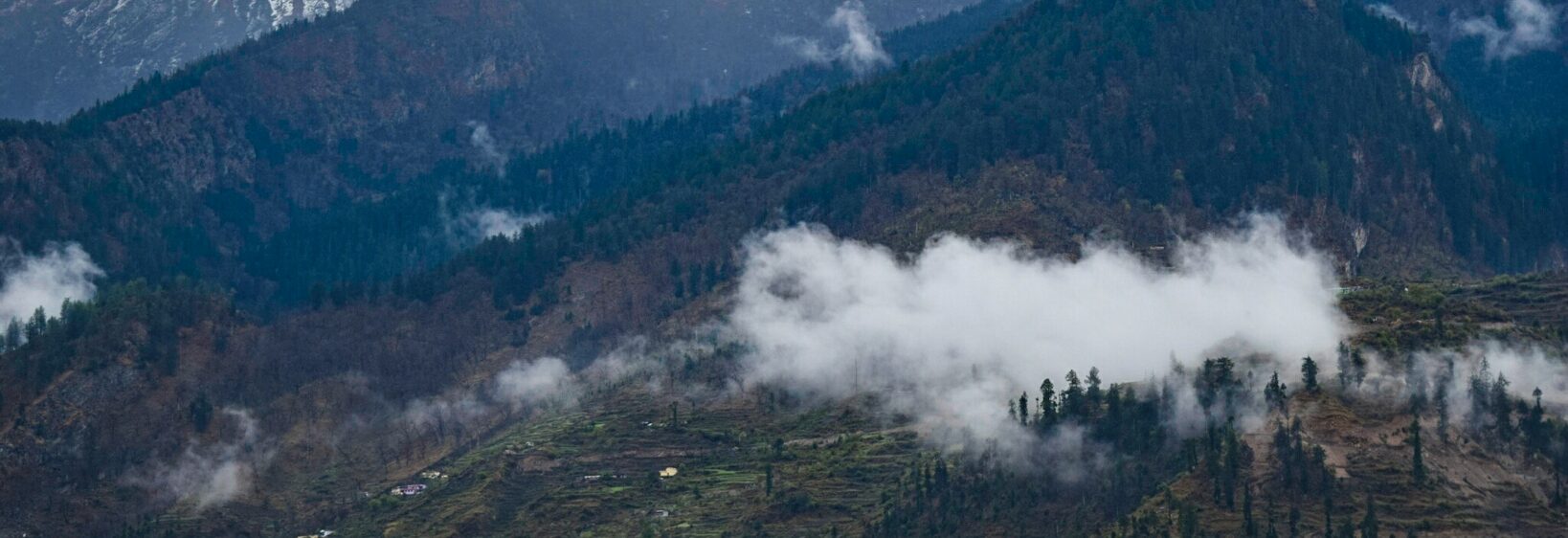
Thathri Village in Uttarakhand: Orchards and Snow Leopard Country
Thathri, also written Thatri, occupies a green mountain shelf in Uttarkashi district, a short climb from Barkot and well below the region’s highest peaks. Apple trees cover the gentler slopes, while pine forest, side valleys and snow-streaked ridgelines define the wider view. The combination gives the village a character found in few parts of India: agricultural calm at one level, wild Himalayan country at another.
Thathri is a working settlement rather than a staged attraction. Orchard families tend compact plots, village paths connect homes and fields, and the rhythm changes with blossom, pruning, harvest and winter. Visitors share that rhythm, which is one reason a short stay can feel more revealing than a hurried stop between larger destinations.
For Australians, the calendar runs in the opposite direction to what many know at home: December and January are cool, clear and cold in Uttarakhand, while spring blossom and the main trekking period arrive from March onwards. The apple districts around Orange, New South Wales, and Tasmania’s Huon Valley provide useful points of comparison, although altitude gives these orchards a distinctly Himalayan character.
The snow leopard is a powerful presence in the district’s identity, yet it is not a guaranteed orchard visitor. Its real territory lies across the high, broken landscapes of Uttarkashi, where concealment is as much a survival skill as camouflage. Any encounter should be treated as an exceptional event, with local knowledge and conservation-minded guiding taking priority over wildlife hype.
Apple orchards and village life
Cultivated slopes carry red and gold apple varieties, including types marketed under names such as Golden, Royal Delicious and Top Spur. Trees stand in narrow bands shaped by contour, drainage and access to sunlight. Some growers sell through roadside stands or aggregators in Barkot and Uttarkashi; others deal directly with visitors. Fruit bought near the orchard often seems fresher and more fragrant than apples carried through several supply chains.
Market day brings crates, paper wrapping and lively bargaining into the lanes. Prices depend on size, variety, weather damage and the day’s supply, so stallholders may quote differently from one another nearby. The UK Photos Gallery provides useful visual context for Uttarakhand village life beyond this single orchard belt.
The orchard calendar
Blossom generally appears from March into April, sometimes dusting an entire slope in pale pink before the petals fall. Picking and grading follow in August and September, when ladders, baskets and temporary labour become part of the scene. October and November often bring the clearest mountain air, although cold can arrive quickly after a bright afternoon.
Rain between June and September can close side roads and wash debris onto the Barkot route. Checking local road conditions before setting out is more useful than relying on a fixed itinerary. Travellers without an Indian SIM should download maps before leaving town, as mobile coverage can vary between the main road and orchard lanes.
Snow leopard country
Thathri is better understood as an orchard settlement within a much larger snow leopard landscape than as a place where sightings are routine. The upper ranges and forested tracts of Uttarkashi, including the Doding and Doibing areas, form part of the wider range. Snow leopards move through steep, rugged terrain and can cover surprising distances when hunting or following prey.
Responsible viewing means accepting that a track, scrape or distant shape may be all a visitor sees. A guide trained to read signs is far more useful than anyone promising a close encounter. Baiting, calling animals or pressuring village livestock should never be part of the search, and sensitive locations require discretion. The Lwani village near Munsiyari offers another perspective on Uttarakhand’s relationship with abandoned mountain settlements, forest edges and seasonal movement.
Reaching Thathri and choosing a stay
The usual approach combines a road journey from Uttarkashi through Barkot with a local transfer into the orchard slopes. Road surfaces can change from smooth highway to patched mountain lane, and landslides sometimes delay the final stretch. A homestay in Thathri or Barkot offers more access to growers and walkers than a brief city stop, but heating, hot water, power backup and mobile signal should be confirmed in advance.
Many travellers leaving Sydney or Melbourne use an Australian travel agent or online travel marketplace for flights, then book the road transfer with an Indian operator. Comparing prices in Australian dollars is convenient, though cancellation terms and confirmed pickup details often matter more than a small headline saving. Broader journey planning resources can offer a second reference when checking the domestic leg of the route.
Cash remains useful at roadside stalls and in smaller family-run stays, even though cards work in many established hotels. UPI is common among Indian businesses, while foreign cards and apps may not function. Australians may also recognise the word arvo for afternoon: a local host or travelling companion might use it to settle a loose pickup time, so confirming the hour in writing avoids a long wait.
A village pace and a wilder horizon
Buying apples directly, sharing meal stories with a host and asking before photographing people or private homes keeps the visit grounded in everyday Thathri. Local guides can explain pruning, weather risks and the routes used by herders, adding context that no viewpoint alone can provide. In conservation terms, that human knowledge is inseparable from the snow leopard’s habitat.
Wildlife tourism becomes most credible when it supports guides, village economies and protection of prey and habitat. Orchards may place visitors within the wider mountain ecosystem, but the experience is measured by patience rather than distance. In Thathri, fruit, forest and wild cats occupy the same narrow corridors of possibility, leaving a stronger impression than a checklist of sightings.